
Companies worldwide invest billions in employee development. How effective those investments are depend on how accurately development needs are defined and how motivated participants are to grow. Objective competency measurement makes it possible to set the right development goal and choose the most appropriate tool, maximizing the impact of each program. Individual assessment and feedback, in turn, strengthen motivation, build acceptance, and create readiness to act. This helps us reduce resistance and work far more effectively on developing the required skills. Our experience over the past two years shows that the main challenges companies face when implementing development programs are:
- Employees and managers have less and less time to devote to development
- Development is still seen as the responsibility of HR or the direct manager rather than the individual
- Groups are increasingly diverse, with significant differences in individual needs
- Development programs continue to be driven by the method rather than the need
- Applying the skills after the program ends remains the greatest challenge
Imagine that a large software company finds that some of its middle managers struggle to delegate tasks to their teams. At first glance, the solution seems clear: training in delegation techniques. In reality, however, each manager is struggling for a different reason:
- Manager A had a bad experience delegating and does not want to try again
- Manager B does not know exactly how to approach delegation
- Manager C finds it very difficult to trust others
A delegation course would address many of these managers’ challenges, but it would be difficult to fully meet the participants’ individual needs and motivations. Competency measurement helps us direct our efforts where they will have the greatest impact. What do we measure, and which tools do we use?
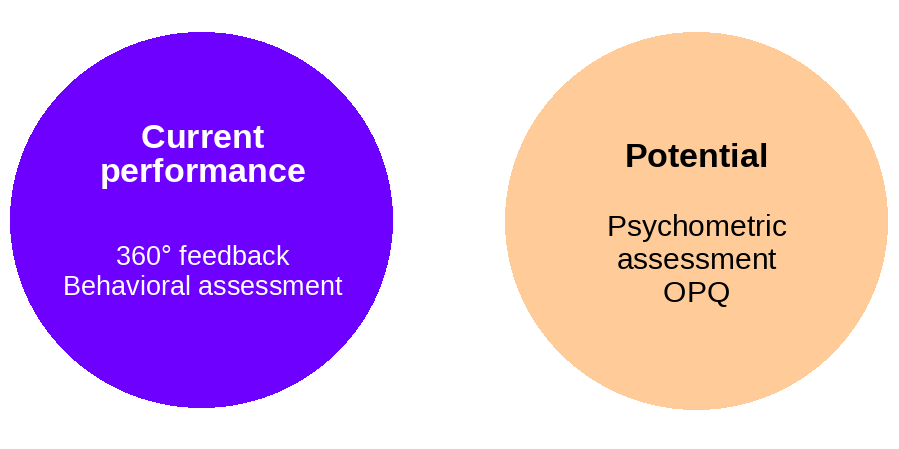
To measure competencies, we use the proven models of SHL, a global leader in talent assessment and management. SHL’s integrated assessment methodology allows us to evaluate both current performance and potential. Potential reflects the extent to which a person’s personality characteristics make certain behaviors and skills natural and easy to develop, or instead make those competencies more difficult to build. Behavior—what a person actually demonstrates—reflects their current level of performance.
Measuring personality characteristics (potential)
We use psychometric tools such as SHL’s Occupational Personality Questionnaire (OPQ), which assesses potential across 20 universal managerial competencies. The psychometric assessment provides information about:
- the extent to which the person has potential regarding a given competency
- which personality characteristics support or hinder the expression of that competency
- how easy or difficult it is likely to be for the person to develop skills in this area
- where development efforts are most likely to be effective
Measuring behavior (performance)
The main tools we use are:
- An Assessment Center, which evaluates behavior through simulations and provides an objective view of the person’s current skill level in context, using a level of complexity appropriate to the business and the hierarchical role.
- 360-degree feedback, which shows how the person is perceived by the people they work with and the extent to which others observe the competencies being assessed.
The greatest value comes from comparing performance—the person’s current skill level or how others perceive them—with potential, as reflected in personality characteristics. This allows development measures to be focused much more precisely: depending on whether a competency comes naturally to the person, we apply different development approaches and tools.
How do we interpret the measurement results?
1. When a person’s potential in a competency is higher than their actual performance, this means they have a natural aptitude for the behaviors associated with that competency and may be able to develop it quickly. The value for the company goes beyond the development of that individual. When potential exceeds what is demonstrated in practice, attention shifts to the context in which the person works. Questions such as “Are they sufficiently motivated?”, “Does the environment provide the right conditions?”, “Do they have the tools they need?”, and “Have they had an opportunity to develop these competencies?” help us not only create a development plan that addresses the person’s specific needs, but also select the intervention most likely to work in that situation.
2. What happens when a person has low potential in a competency but needs to demonstrate the related behaviors to perform their role? Consider a hypothetical employee, Ivan—a high-performing manager selected as a successor for a key position. There is one area, however, in which Ivan consistently receives negative feedback: he leaves many tasks unfinished and delays feedback or approval on projects, making the work of the entire team more difficult. According to his results on SHL’s Occupational Personality Questionnaire (OPQ), Ivan has lower potential in two competencies:
- planning and organizing
- delivering results and meeting customer expectations
According to SHL’s Manager Plus interpretive report, Ivan’s personality characteristics suggest that he:
- sees deadlines as flexible rather than binding and tends to leave tasks unfinished
- does not see monitoring progress against deadlines as a priority
These two personality characteristics stand in his way and underpin the behavior we observe. In this case, personal effectiveness training alone would not be enough, because the issue is not simply a lack of skills but personality patterns developed over many years. With this information, we can create a comprehensive plan involving not only Ivan, but also the people he works with. Together with Ivan, we identify practical steps to mitigate these tendencies and keep the work moving smoothly:
- Personal effectiveness training
- Individual coaching sessions with Ivan to discuss upcoming projects and deadlines
- Recording the deadline for every task in a shared calendar
- Agreeing that members of Ivan’s team will take responsibility for monitoring each deadline, becoming the active party and checking whether he is on track
- Focusing on setting and accepting more realistic deadlines
In other words, low potential in a particular competency certainly does not mean that nothing can be done. The person may build on their strengths, delegate this type of task, find a mentor who can support them, or create systems and processes that compensate for the gap.
What does measurement give us?
- A focus on the real need rather than its outward expression or symptom
- A need-led rather than tool-led approach
- An individualized approach
- Better application because the intervention addresses the real need
How does this approach address the challenges facing development programs? Objective measurement and an individual development plan:
- Put responsibility in the hands of the program participant
- Make the process easier for managers, development specialists, and participants
- Help address the shortage of time
- Turn group diversity into an advantage
- Keep the focus on application
Measurement gives development programs the right foundation for people to build their competencies in a focused way, aligned with the specific needs of both the individual and the company. This helps ensure that we get the greatest possible value from our investment in development.
Note: Competencyassessment through OPQ and the related feedback can also be delivered entirely online under preferential terms. For an individual proposal, contact us at contact@ninetynine.bg